
3 Essential Systems for Organizing Garage Tools
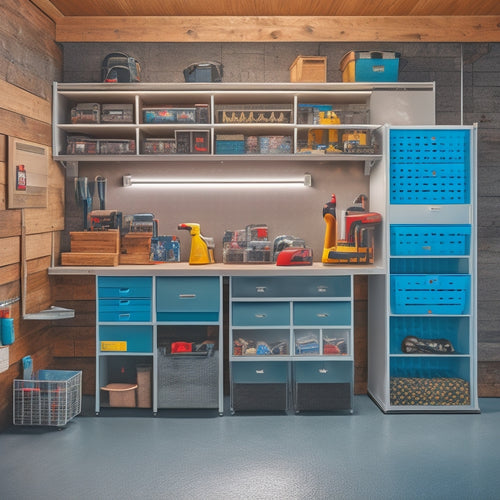
To achieve a clutter-free and efficient garage, you'll need to establish three essential systems for organizing your tools. First, categorize and group your tools by type, frequency of use, and size. Next, assign designated storage spaces based on size, shape, and frequency of use, allocating prime space near your workbench for frequently used tools. Finally, implement a labeling and signage system, using color-coding to differentiate tool categories and enhance visual identification. By putting these systems in place, you'll be well on your way to a garage that's optimized for productivity - and there's even more to explore to take your organization to the next level.
Key Takeaways
• Categorize and group tools based on type, frequency of use, and size to ensure efficient storage and easy access.
• Assign designated storage spaces for each tool category, considering size, shape, and frequency of use for optimal organization.
• Implement a labeling and signage system, including color-coding, to quickly identify tools and enhance organization.
• Store frequently used tools in easily accessible locations, such as near the workbench, for increased productivity.
• Utilize pegboard organization and tool chest storage to maximize space and keep the garage clutter-free.
Categorizing and Grouping Tools
Sort your tools into categories, such as hand tools, power tools, and automotive tools, to create a logical and functional system that makes sense for your specific needs. This step is vital in achieving effective tool organization. You'll be able to quickly identify where each tool belongs and find what you need when you need it.
Within each category, group similar tools together, such as all wrenches or all drills. This will make it easy to compare and contrast similar tools, ensuring you're using the right one for the job. Consider the frequency of use and the size of each tool when grouping them.
Store frequently used tools in easy-to-access locations, and reserve harder-to-reach areas for less frequently used tools. By doing so, you'll optimize your tool organization and storage solutions. A well-thought-out categorization system will help you maintain a clutter-free garage and reduce wasted time searching for misplaced tools.
Assigning Designated Storage Spaces
With your tools categorized and grouped, it's time to designate a specific storage space for each group, taking into account the size, shape, and frequency of use of each tool. This step is essential in maintaining your organized garage.
For frequently used tools, consider allocating space near your workbench or in a convenient location. Less frequently used tools can be stored in harder-to-reach areas, like high shelves or in a separate storage room.
Pegboard organization is an excellent way to store small to medium-sized tools, such as wrenches, pliers, and screwdrivers. Hang a pegboard on a wall or on the back of a door, and use hooks, bins, and holders to store your tools.
For larger tools, like power tools and machinery, assign a specific area in your tool chest storage. Use dividers or bins to separate and organize these tools, ensuring easy access when you need them.
Implementing Labeling and Signage
By labeling each storage space and adding clear signage, you'll make sure that you and others can quickly identify where specific tools are stored, even when they're not in use. This system guarantees that you can find the tool you need in a snap, saving you time and frustration.
To take your labeling and signage to the next level, consider implementing a color-coding system. Assign a specific color to each category of tools, such as red for power tools, blue for hand tools, and green for gardening tools. This visual cue will assist you and others in quickly identifying where a tool belongs.
Here's an example of how you can organize your tool inventory using color coding and signage:
| Tool Category | Color Code | Signage |
|---|---|---|
| Power Tools | Red | 'Drills and Saws' |
| Hand Tools | Blue | 'Wrenches and Pliers' |
| Gardening Tools | Green | 'Rakes and Hoes' |
| Automotive Tools | Yellow | 'Tire Pressure and Oil' |
Frequently Asked Questions
How Often Should I Clean and Maintain My Garage Tool Organization System?
You should clean and maintain your garage tool organization system every 1-3 months, depending on usage, to prevent clutter and maintain efficiency; set a schedule and stick to it, and don't forget to dust and purge unused tool storage.
Can I Use a Pegboard for Storing Small or Heavy Tools?
You can definitely use a pegboard for storing small or heavy tools, considering the tool weight and pegboard versatility. Small tools fit snugly, while pegboard durability guarantees heavy tools stay securely in place.
Are There Any Specific Safety Considerations for Garage Tool Storage?
Imagine a fire-breathing dragon lurking in your garage, waiting to release chaos. You can tame it by taking safety precautions, ensuring proper ventilation, and storing flammable liquids and hazardous materials in well-ventilated areas, away from heat sources.
How Do I Prevent Tools From Getting Rusty or Corroded in Storage?
To prevent tools from getting rusty or corroded in storage, you'll want to dry them thoroughly after use, apply a rust-inhibiting coating, and store them in a dry, ventilated area with silica gel packets for corrosion control.
Can I Customize My Garage Tool Organization System for Left-Handed Users?
"As a lefty, you're in luck! You can swap out traditional tool holders for left-handed ones, or opt for customized storage options that cater to your unique needs, ensuring a seamless workflow in your garage."
Related Posts
-
Organize Your Garage: Tool Storage Solutions Revealed
You're about to transform your cluttered garage into a highly efficient workspace by implementing a customized tool s...
-

Why Large Musical Instruments Need Specialized Storage
You know your large musical instrument is a valuable asset that requires precise care and handling to preserve its be...
